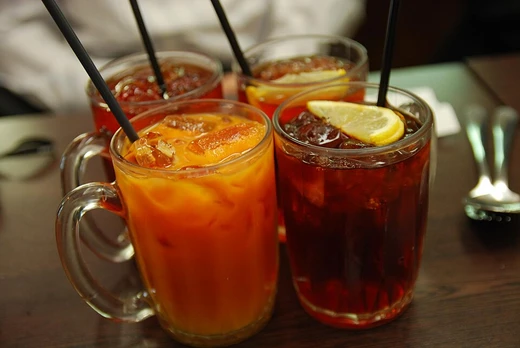
Apple juice
A globally common fruit juice made from pressed apples.

Apple juice is a fruit juice made by the maceration and pressing of an apple. The resulting expelled juice may be further treated by enzymatic and centrifugal clarification to remove starch and pectin, and then pasteurized for packaging or dehydrated to a concentrate. It is one of the most common fruit juices globally, with world production led by China, Poland, the United States, and Germany.
- type
- Beverage
- primary_ingredient
- Apple
- common_cultivar
- McIntosh
- typical_pH
- 3.4
- water_content
- 88%
- calories_per_100ml
- 46
- major_producers
- China, Poland, United States, Germany
Lore & Background
Apples used for apple juice are usually harvested between September and mid-November in the Northern Hemisphere and between February and mid-April in the Southern Hemisphere. A common cultivar used is the McIntosh, with approximately two medium apples producing around 200 millilitres of juice. After picking, apples are washed and transported to the processing facility, then pressed and juiced right away to avoid spoilage. Depending on the company and end-product, apples can be processed in different ways before pressing. The juice is then filtered, with the number of solid particles partly defining the difference between apple juice and apple cider. When treated enzymatically, the typical class of enzymes used are pectinases.
Reader's Guide
Apple juice is produced commercially due to the complex and costly equipment required for large-volume extraction and clarification. In the United States, unfiltered fresh apple juice is made by smaller operations in areas of high apple production, in the form of unclarified apple cider. Because apple juice is acidic (pH 3.4), it can be pasteurized for less time or at lower temperatures than many other juices; the U.S. Food and Drug Administration recommends specific thermal processing times to achieve a five-log reduction of Cryptosporidium parvum. coli, Salmonella, Cryptosporidium, Clostridium botulinum, and hepatitis A. Apple juice is 88% water and 11% carbohydrates, providing 46 calories per 100 ml with no significant micronutrients. Fresh juice requires refrigeration; sealed bottles can be stored in a dark, cool place, and once opened must be refrigerated between 0°C and 4°C. While apple juice generally refers to the filtered, pasteurized product, an unfiltered and sometimes unpasteurized version is commonly known as 'apple cider' in the United States and parts of Canada, though legal distinctions are not universal.
Did You Know?
- Approximately two medium McIntosh apples produce around 200 millilitres of juice.
- Apple juice has a typical pH of 3.4, allowing pasteurization at lower temperatures than many other juices.
- World production of apple juice is led by China, Poland, the United States, and Germany.
The Foundation of Cider
Apple juice serves as the raw material from which cider is produced through the process of fermentation. This alcoholic beverage, when crafted from apple juice, carries an alcohol content that spans a remarkable range—from a modest 1.2% ABV up to 8.5% or even higher in the case of traditional English ciders. The transformation from a simple fruit juice into a fermented drink places apple juice at the starting point of an entire category of alcoholic beverages. In certain regions around the world, the finished product carries a different name altogether, being referred to as apple wine rather than cider, which underscores how the same base ingredient can yield beverages with distinct cultural identities depending on geography and tradition. The existence of dedicated brand listings for cider further illustrates how apple juice, once subjected to fermentation, has carved out a recognizable commercial niche within the broader alcoholic drinks market.
Cultural and Commercial Context
Apple juice exists within a vast landscape of consumable liquids that extend far beyond mere hydration. Drinks as a category are not simply functional necessities; they form an integral part of human cultural expression and social development. In commercial and retail settings, liquids other than plain water are commonly designated as beverages, a term that encompasses apple juice among thousands of other products on the shelf. This cultural dimension means that apple juice is not merely a nutritional item but a participant in the broader tapestry of what societies choose to consume, share, and celebrate. The fact that alcoholic drinks have been woven into human culture and development for approximately nine thousand years highlights how deeply embedded the act of drinking is in civilization, and apple juice occupies a place within that long tradition both as a standalone refreshment and as the precursor to fermented products like cider.
Role as a Sweetening Agent
Beyond its identity as a standalone beverage, apple juice occupies a functional role in the formulation of soft drinks. A soft drink is typically constructed from water—frequently carbonated—combined with a sweetener and a flavoring agent. The sweetener component may take the form of sugar, high-fructose corn syrup, fruit juice, sugar substitutes for diet varieties, or some blend of these options. Apple juice, as a fruit juice, fits squarely within this category of natural sweetening agents. This means that in many commercial soft drink products, apple juice contributes not as the star ingredient but as a background element that adds sweetness and a subtle fruity character to the overall flavor profile. The soft drink category itself is extraordinarily diverse, spanning craft sodas, lemon-based drinks, and national beverages from around the world, and apple juice can appear as one of many possible sweetening choices in this wide spectrum of products.
The Alcoholic and Non-Alcoholic Divide
Apple juice sits at an interesting crossroads in the classification of drinks. In its natural, unfermented state, it is a non-alcoholic liquid—a drink that can be consumed without any psychoactive effects. However, the moment it undergoes fermentation, it becomes the base for cider, an alcoholic beverage. This duality mirrors a broader pattern in the drinks world, where the term non-alcoholic often refers to products that would normally contain alcohol, such as beers and wines, but have been subjected to an alcohol removal process to bring their content below 0.5 percent ABV. Apple juice, by contrast, never required such a process; it is inherently alcohol-free until human intervention transforms it. The distinction between undistilled and distilled drinks, where the latter are considered harder due to their elevated alcohol content, further contextualizes where apple juice-based products like cider fall on the spectrum of alcoholic strength.
Frequently Asked Questions
Who is Apple juice?
Apple juice is a globally common fruit beverage produced by macerating and pressing whole apples to extract their liquid. It is composed of roughly 88% water and carries a typical pH of 3.4, giving it a mildly tart profile.
What are Apple juice's powers/role?
Apple juice delivers 46 calories per 100 ml and serves as one of the most widely consumed fruit juices on the planet. Its role in drink culture spans everything from a children's lunchbox staple to a base for cocktails and smoothies.
How does Apple juice's story end?
After pressing, the raw juice undergoes enzymatic and centrifugal clarification to strip out starch and pectin before being pasteurized for shelf-stable packaging or dehydrated into a reconstitutable concentrate. That final step—whether a carton on a grocery shelf or a syrupy concentrate in a can—marks the end of its production arc.
Why is Apple juice important?
Apple juice ranks among the most produced fruit juices worldwide, with China, Poland, the United States, and Germany leading global output. Its ubiquity makes it a cornerstone of both everyday hydration and the broader fruit-juice industry.
What is Apple juice's origin story?
Apple juice's origin begins with the apple itself, most commonly the McIntosh cultivar, which is prized for its balance of sweetness and acidity. The fruit is crushed and pressed, and the expelled liquid becomes the raw material for everything that follows.
More in Beverages & Drink Culture 1-18
Spotted an error? Know more?
This is a living reference — every entry is fact-audited, and reader corrections feed straight into our audit queue. Suggest an edit · See this site's audit record